
Assessments
See Clearly. Understand Deeply. Act Intentionally.
ASSESSMENTS THAT TURN AWARENESS INTO ACTION
Understanding yourself is only the beginning.
What you do with that understanding is what creates meaningful change.

Self-awareness is powerful—but awareness alone doesn’t create change.
The right assessment can reveal patterns, strengths, motivations, blind spots, emotional tendencies, competencies, and other factors that are often difficult to recognize on our own. It gives us meaningful information to work with—and a clearer place to begin.
At LIG Coaching & Consulting, assessments are not used to label you, define you, or put you in a box. They are carefully selected and integrated into coaching, leadership development, relationship work, team development, organizational consulting, and professional mentorship to turn greater understanding into intentional action.
Because the goal isn’t simply to know more about yourself.
It’s to use what you learn to live, communicate, lead, relate, and work more effectively.
The assessment is the beginning—not the answer.
An assessment can provide extraordinary insight. But a report sitting on a shelf doesn’t create transformation.
The real value comes from understanding what the information means, recognizing where it is already showing up in your life and work, and learning how to apply it in ways that create meaningful and sustainable change.
With more than two decades of coaching experience, Marcus helps clients move beyond scores, graphs, and terminology to connect assessment insights with real-world behaviors, relationships, challenges, goals, and opportunities.
Insight creates possibility. Integration creates change.

Assessment Sciences
Different Sciences. Different Questions. A More Complete Picture
No single assessment can capture the complexity of a human being. That’s why Marcus works with multiple assessment sciences and selects the tools that best fit the individual, relationship, leader, team, organization, or objective at hand

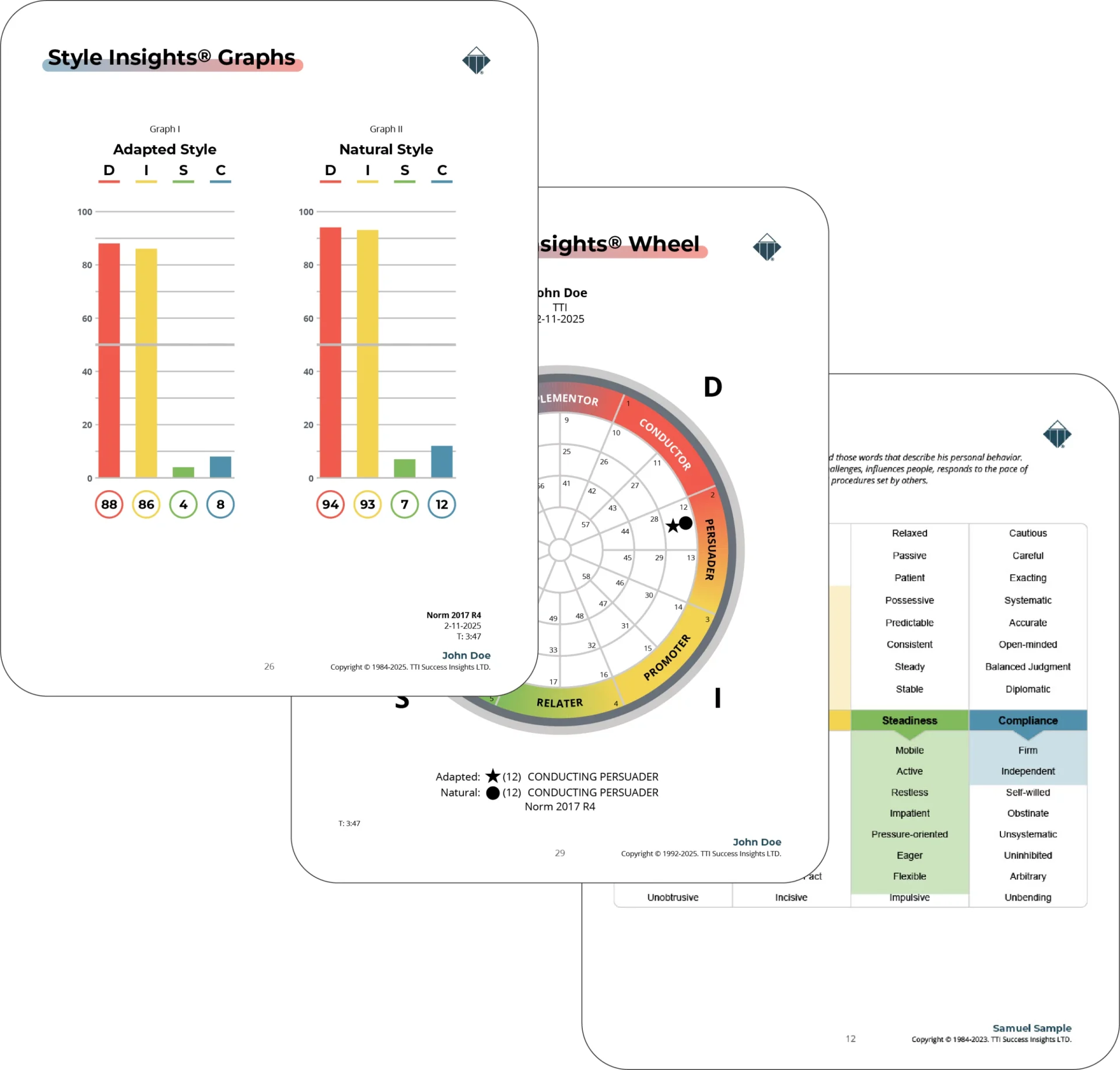
DISC
How do you behave and communicate?
DISC provides insight into observable behavioral and communication styles—how you tend to approach problems, interact with people, respond to pace and change, and navigate rules and procedures.
Understanding these patterns can improve self-awareness, communication, collaboration, leadership, relationships, and the ability to adapt more intentionally to others.
May help illuminate:
Communication • Behavioral Style • Relationships • Adaptability • Leadership • Team Dynamics
More About the Science
DISC (Behaviors)
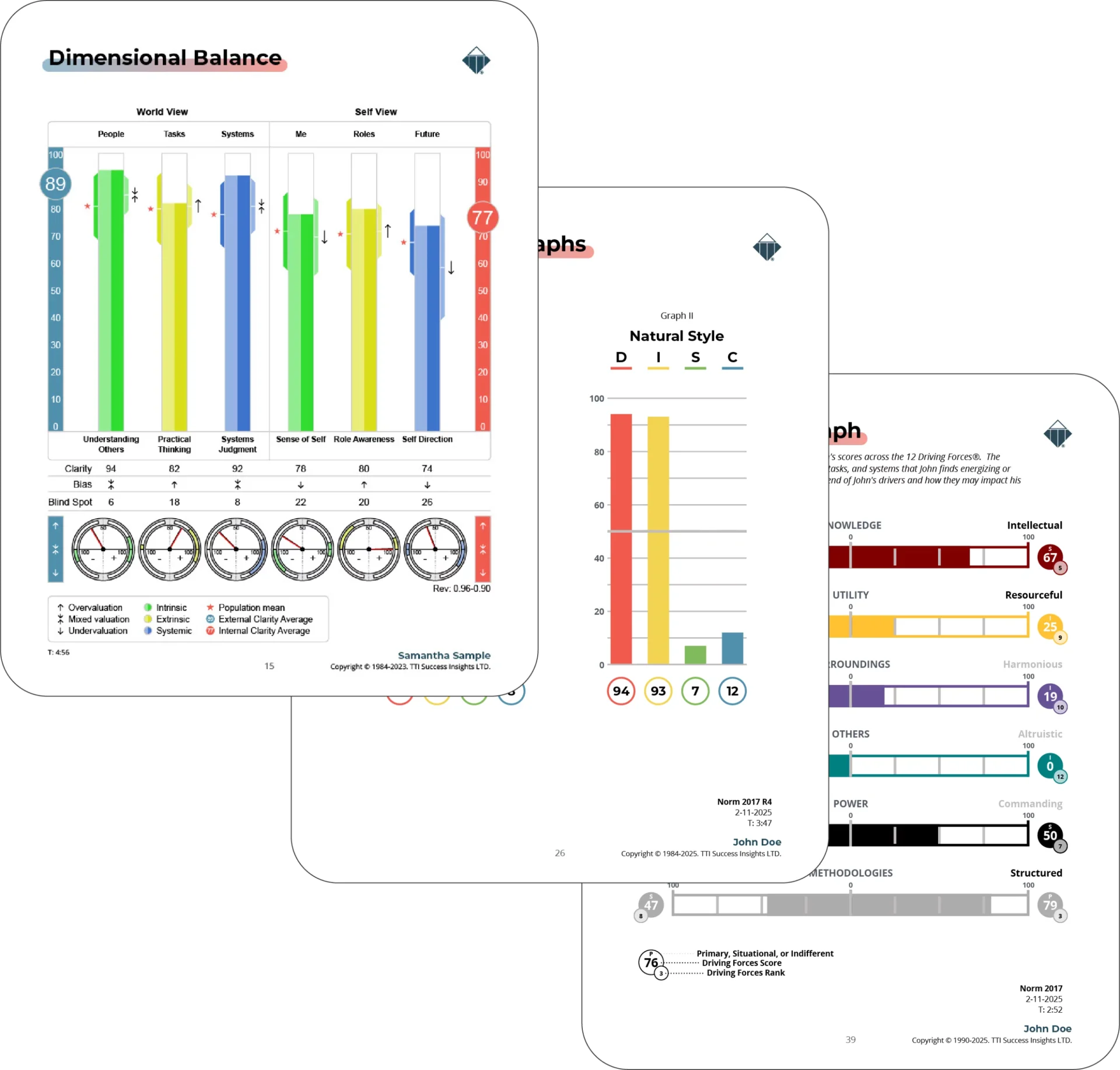
TTI’s DISC assessment measures how a person does what they do through four behavioral factors: Dominance, Influence, Steadiness, and Compliance.
It explores observable behavior and reveals how a person will likely perform, including how they prefer to communicate, what they will bring to a team, their ideal environment, and possible limitations they may face.
DISC helps:
Minimize conflict
Increase productivity and engagement
Enhance communication
Maximize strengths
Turn challenges into opportunities
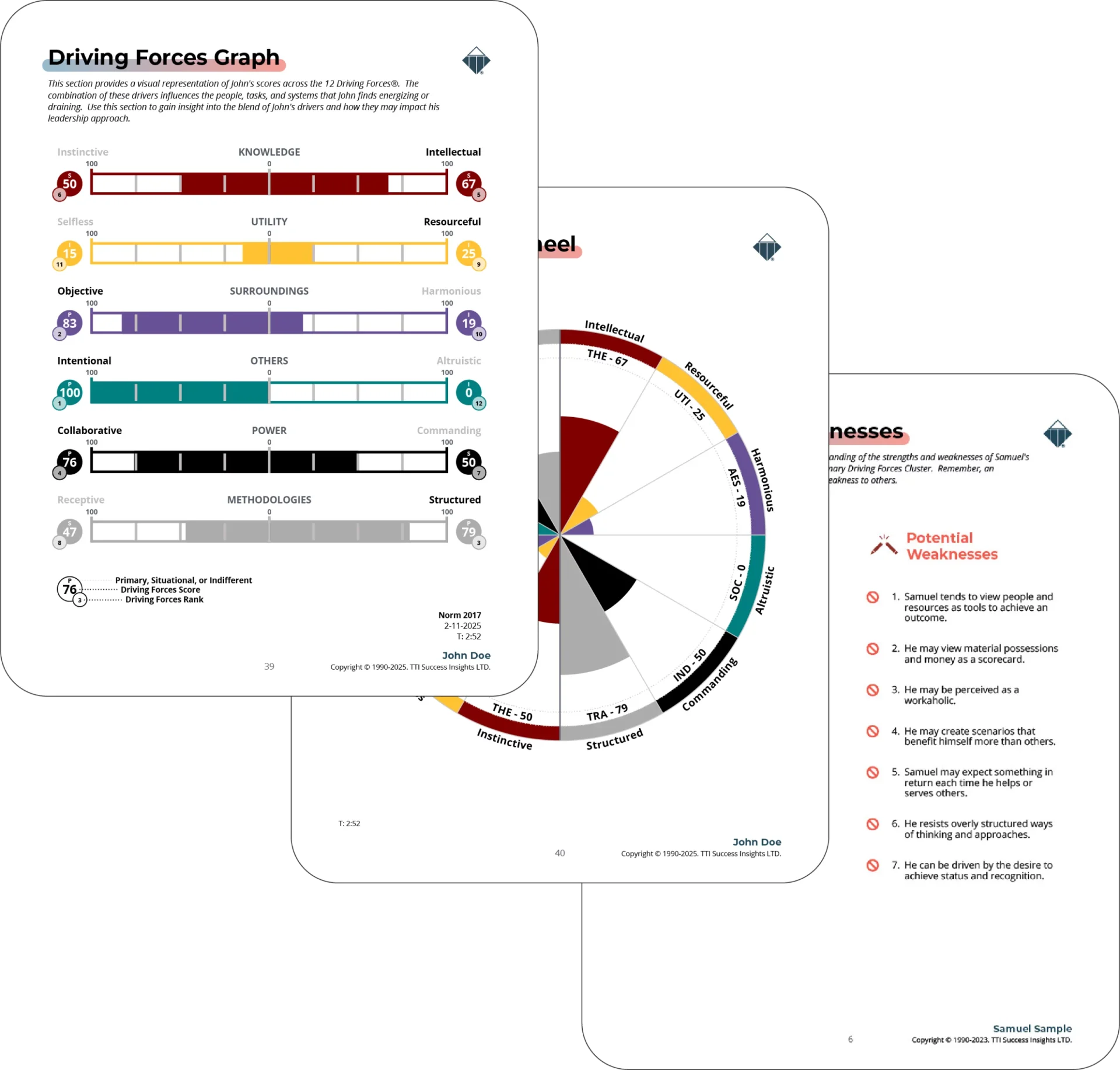
12 DRIVING FORCES®
Why do you do what you do?
Behavior tells us how someone tends to act. Driving Forces help uncover the motivations behind those actions.
This science explores what energizes, engages, and motivates an individual, providing greater understanding of why certain environments, opportunities, decisions, and interactions feel meaningful while others may create frustration or disengagement.
May help illuminate:
Motivation • Values • Decision-Making • Engagement • Purpose • Workplace Fit
More About the Science
12 Driving Forces® (Motivators)
The 12 Driving Forces® assessment explores motivation and engagement through six factors, measuring why a person does what they do.
At the core of 12 Driving Forces® are six motivators, rooted in Eduard Spranger’s esteemed research from 1928. This assessment reveals what sparks action and ambition in a person, as well as what impacts their decision-making.
12 Driving Forces® helps:
Find real meaning in work
Uncover areas of opportunity
Drive meaningful development
Improve performance
Boost engagement and retention


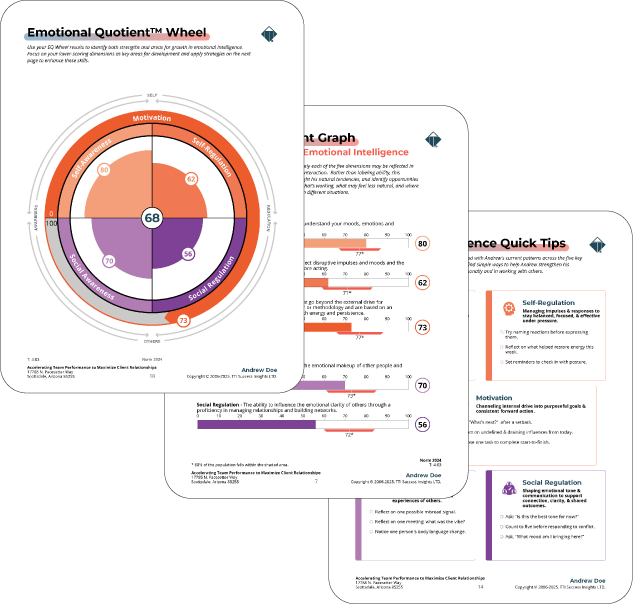
EMOTIONAL QUOTIENT (EQ)
How effectively do you understand and manage emotion?
Emotional intelligence influences how we understand ourselves, regulate our responses, perceive others, navigate relationships, and make decisions—especially when pressure is high.
EQ insights can help individuals and leaders strengthen emotional awareness and regulation while improving communication, relationships, resilience, and leadership effectiveness.
May help illuminate:
Self-Awareness • Self-Regulation • Empathy • Relationships • Resilience • Leadership
More About the Science
EQ (Emotional Intelligence)
EQ assessment measures a person’s emotional intelligence, or ability to sense, understand, and effectively apply emotions for higher levels of collaboration and productivity.
It examines five key areas pertaining to intrapersonal and interpersonal relations: self-awareness, self-regulation, motivation, social awareness, and social regulation.
EQ helps:
Improve self-awareness and social awareness
- Improve self regulation and social regulation
Drive personal and professional growth
Support stress management
Work well with a wide variety of people
Respond effectively to rapidly changing conditions
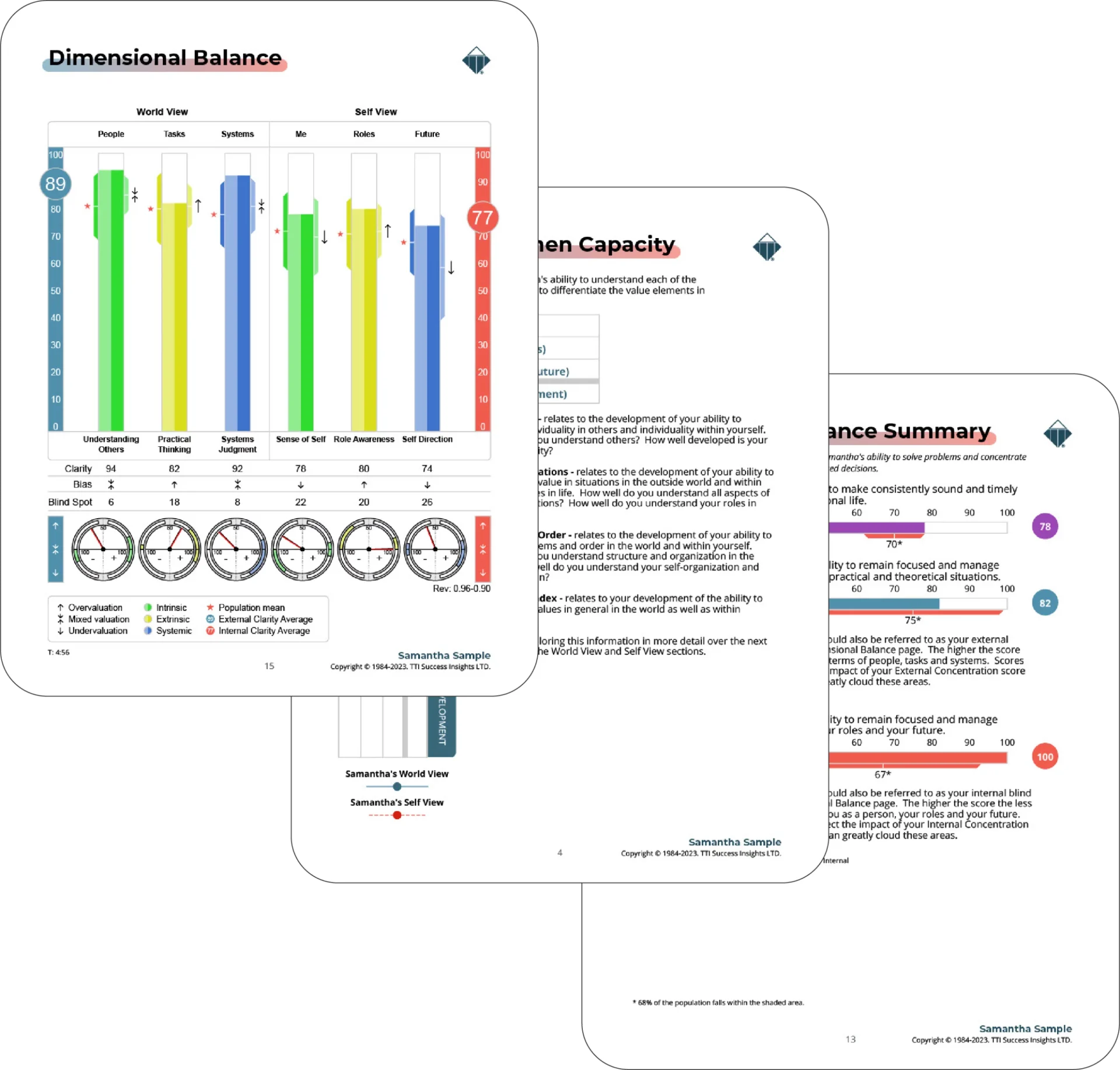
ACUMEN CAPACITY INDEX (ACI)
How do you perceive yourself and the world around you?
ACI explores how an individual thinks, perceives, and makes judgments about themselves and their external environment.
These insights can uncover patterns in thinking and decision-making that influence clarity, problem-solving, self-perception, relationships, leadership, and the ability to navigate complexity.
May help illuminate:
Thinking • Perception • Judgment • Decision-Making • Self-Understanding • Problem-Solving
More About the Science
ACI (Judgement)
The Acumen Capacity Index (ACI) report measures how a person thinks or perceives information.
Based on a science called Axiology, ACI measures the capacity and clarity of understanding the world and self, while revealing the blind spots that are created by emotional biases.
Acumen is assessed using three dimensions of thought, analyzing both world and self-views: Intrinsic (feeling), Extrinsic (doing), and Systemic (thinking).
ACI helps:
Strengthen problem-solving skills
Enhance decision-making
Unveil thought processes
Optimize performance and potential
Promote self-improvement and alignment



DNA / COMPETENCIES
What skills and competencies do you bring to the table?
Competency assessments help identify developed strengths and areas for growth across skills that contribute to personal and professional effectiveness.
These insights can be especially valuable for leadership development, role alignment, career planning, succession, hiring, and identifying where focused development may create the greatest impact.
May help illuminate:
Competencies • Strengths • Development • Leadership • Role Alignment • Performance
More About the Science
DNA (Competencies)
The Competencies assessment measures the development of 25 personal skills (or soft skills) required in any job, ranking them from ‘Not As Pronounced’ to ‘Very Pronounced’.
Our research has shown that, for many jobs, personal skills are just as important as technical skills in producing superior performance. Personal skills are often transferable to different jobs, whereas technical skills are usually more specific.
DNA helps:
Guide professional development
Improve organizational performance
Support targeted coaching and training
Enhance role alignment
Identify strengths and development opportunities
MULTI-SCIENCE ASSESSMENTS
What becomes visible when the sciences work together?
Human beings are multidimensional. Multi-science assessments combine multiple assessment perspectives to create a more integrated picture of behavior, motivation, emotional intelligence, competencies, or other relevant factors.
By looking at how these dimensions interact rather than examining each one in isolation, Marcus can help clients uncover patterns, tensions, strengths, and opportunities that may otherwise remain hidden.
May help illuminate:
Whole-Person Insight • Leadership • Role Alignment • Performance • Development • Integration
More About the Sciences & Report Options
Multi-Science Assessments
A multi-science approach means using multiple assessments to measure different aspects of a person. While one assessment is powerful, combining multiple assessments is a catalyst to unlocking deeper understanding, engagement, and development.
Multiple sciences progressively reveal more of a person—what they do, how they do it, and why they do the things they do. Our approach also measures both the presence and absence of behavior, as well as acceptance and avoidance. This creates the full picture and exponentially reveals human potential.
Multi-Science strategy helps:
Go deeper into self-awareness and personal insight.
Understand the setup required to do optimal work.
Enhance work with colleagues and leadership ability.
Create a robust professional development plan.
Develop mastery of strengths.
Multi-Science assessment options include:
TTI Talent Insights® > DISC + 12 Driving Forces®
TriMetrix® ACI > DISC + 12 Driving Forces® + ACI
TriMetrix® DNA > DISC + 12 Driving Forces® + DNA
TriMetrix® EQ > DISC + 12 Driving Forces® + EQ
TriMetrix® HD > DISC + 12 Driving Forces® + DNA + EQ
The TTI Talent Insights® report is available for download here. Please contact LIG Coaching & Consulting to request TriMetrix® ACI, DNA, EQ, and HD sample reports.



STRESS QUOTIENT
Where is stress affecting your ability to perform & thrive?
Stress affects people differently—and understanding where it originates is an important first step toward managing it more effectively. The Stress Quotient assessment provides a snapshot of stress across seven key categories, identifying areas that may be affecting well-being, performance, relationships, and effectiveness.
For individuals, teams, and organizations, SQ helps reveal where stress is showing up so underlying factors can be explored and addressed more intentionally.
May help illuminate:
Sources of stress • Areas of pressure • Stress patterns • Impact on performance & well-being • Opportunities for greater resilience
More About the Science
Stress Quotient (SQ)
The Stress Quotient assessment measures stress across 7 categories and 17 sub-segments, providing individuals, teams, and organizations with a snapshot of where stress is being experienced.
Because people perceive and respond to stress differently, greater awareness can help identify where stress may be affecting well-being, performance, and effectiveness. SQ is a diagnostic tool designed to identify areas of focus so the factors contributing to stress can be better understood and addressed.
SQ helps:
Identify sources and levels of stress
Increase awareness of stress patterns
Highlight areas requiring attention
Compare stress across teams and departments
Guide strategies for reducing and regulating stress
8 FACTORS OF ENGAGEMENT® (8FE)
What fuels—or limits—your engagement?
Engagement affects how people experience their work, contribute to teams, connect with purpose, and perform within an organization.
The 8 Factors of Engagement® model examines eight interconnected factors to help individuals, teams, leaders, and organizations understand where engagement is strong, where people may be getting stuck, and where intentional action can create meaningful improvement..
The 8 Factors of Engagement:
Purpose • Accountability • Trust • Resources • Care • Recognition • Agility • Development
More About the Science
8 Factors of Engagement® (8FE)
The 8 Factors of Engagement® assessment measures engagement at the individual, team, and organizational level, helping identify where people are engaged, where they may be stuck, and what factors may be influencing their experience at work.
Engagement is closely connected to performance, trust, shared purpose, and the overall employee experience. 8FE provides individuals with a confidential profile designed to increase awareness of their own engagement while giving teams and leaders actionable insight to support greater engagement across the organization.
8FE helps:
Measure individual, team, and organizational engagement.
Identify where people are engaged or may be stuck.
Increase personal ownership of engagement.
Provide actionable feedback for leaders and teams.
Develop a sustainable culture of engagement and performance.


TARGET SELLING INSIGHTS (TSI)
Where can greater sales insight create stronger performance?
Effective selling goes far beyond closing a deal. Target Selling Insights provides a clear view of sales effectiveness across six critical stages of the sales process—from identifying prospective buyers and building trust to uncovering needs, communicating value, navigating objections, and gaining commitment.
For sales professionals, leaders, and teams, TSI helps identify strengths and development opportunities so coaching and training can be more focused, practical, and relevant to real-world sales performance.
May help illuminate:
Sales strengths & development opportunities • Overall sales acumen • Prospecting & relationship-building effectiveness • Opportunities for targeted sales development
More About the Science
Target Selling Insights (TSI)
Target Selling Insights measures sales effectiveness across six critical stages of the sales process, helping individuals and teams understand where they are strongest and where focused development may improve performance.
The assessment examines the TARGET sales strategy—Target, Adapt, Research, Guide, Explain, and Transition—from identifying prospective buyers and building trust to uncovering needs, communicating value, navigating objections, and gaining commitment.
TSI helps:
Identify strengths and development opportunities throughout the sales process
Measure overall sales acumen and effectiveness
Improve specific selling skills through targeted development
Focus coaching & training on areas with the greatest opportunity for growth
Build greater confidence and consistency across the sales cycle
ASSESSMENTS IN ACTION
Where Insight Becomes Meaningful Application
Core Coaching Programs

The Aligned Individual™
Build Clarity, Confidence & Direction

The Connected Relationship™
Strengthen Trust & Connection

The Intentional Leader™
Lead with Greater Awareness & Impact

The Caring Company™
Align People, Culture & Performance
Broader Application

Listening with Integrity™
Listening & Communication
